 Ghanatodayonline.com News, Politics, Health, Education & More
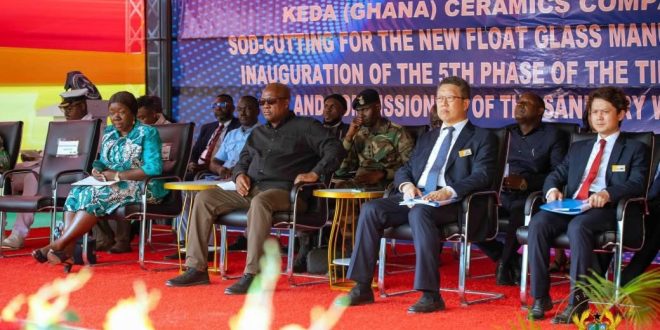
President John Mahama has inaugurated the groundbreaking for a $250 million float glass manufacturing facility in Shama, Western Region, calling the initiative a significant advancement in bolstering Ghana’s industrial foundation.
The event additionally celebrated two other achievements: the launch of a contemporary sanitary ware factory and the opening of Phase Five of the ceramic tile production line by KEDA (Ghana) Ceramics Company Limited.
During the event, President Mahama remarked that Ghana still depends significantly on imported glass products.

He mentioned that in 2024, the nation brought in over 65,000 tonnes of glass items worth close to $25 million to fulfill the demands of the construction, automotive, and manufacturing industries.
He claimed that the new float glass factory would alter that circumstance. Phase One of the project will generate 600 tonnes each day, whereas Phase Two will contribute an additional 800 tonnes, raising the total production capacity to 1,400 tonnes per day. Once finished, it is anticipated to be among the biggest float glass plants in Africa.
The President stated that the factory will cut down imports, conserve foreign currency, enhance supply chains, and establish Ghana as a regional exporter of glass. When operating at full capacity, export revenues are expected to reach nearly 100 million dollars each year. “Production, not speculation, strengthens a currency,” he said.

He stated that the growth of the tile production line in Phase Five will enhance output by 40,000 square metres each day, boosting total tile production to 200,000 square metres daily.
The firm currently exports to over 20 nations, such as the United States, Italy, France, Mexico, Peru, and Brazil. The President stated that this demonstrates the competitiveness of made-in-Ghana products on a global scale.
Regarding revenue and employment, President Mahama revealed that in 2025, the company paid GH₵740 million in taxes to the Ghana Revenue Authority.
Once the float glass factory is in full operation, yearly tax contributions may go beyond GH₵1 billion. “This is how we build schools, hospitals, and roads,” he stated.

The initiative is anticipated to create approximately 2,182 direct employment opportunities, with 729 during the construction phase and 1,453 ongoing roles after operations start. Thousands of indirect employment opportunities are also expected.
The President remarked that there is an organized localisation and skills transfer initiative to guarantee that Ghanaian engineers, technicians, and managers progressively take on leadership positions.

He stated that the investment corresponds with the government’s 24-Hour Economy initiative and export development plans, along with Ghana’s position as the host of the Secretariat of the African Continental Free Trade Area. He emphasized that prosperity is not achieved solely through trade agreements. “Creation and enhancement do.” “Production and value addition do.”

President Mahama commended Chairman Shen, the management of KEDA Ghana Ceramics, the Ministry of Trade and Industry, the traditional authorities of Shama, engineers, workers, and the young people involved in the project.
At the event, President Mahama urged factory management and staff to take ownership of the facility, stressing that Ghana’s industrialization will succeed only through a partnership of stable government policy, private investor capital, and strong community engagement. He reiterated his administration’s confidence that “Made-in-Ghana” products can compete internationally through skill, innovation, and uncompromising quality.

KEDA’s expansion, which combines a new float glass plant with increased tile production capacity and a sanitary wares factory, forms part of broader efforts to deepen Ghana’s manufacturing sector. Backers say the integrated approach will create efficiencies across construction-material supply chains and help retain value within the local economy.

The commencement of the Shama project comes as the government pushes an industrialization agenda that prioritizes import substitution, export growth and job creation. Details on the project’s timeline, total investment cost and the precise number of jobs to be created were not disclosed at the ceremony.
Source: Ghanatodayonline.com